
Part of the guide: Gentle Parenting in Islam: The Complete Guide for Muslim Moms
How to Stop Yelling at Your Kids: 7 Sunnah Steps
You asked nicely. Then you asked again. By the third time, the shoes are still in the hallway, the baby is crying, the pot is boiling over — and the words leave your mouth louder than you ever meant them to. The house goes quiet. Your child’s face changes. And a few minutes later, the guilt arrives.
If that moment feels familiar, you are not a bad mother. You are a tired one, carrying a lot. And the good news is that learning how to stop yelling at your kids is not about becoming a different person overnight. It is about learning a few small, repeatable habits — and the Sunnah of the Prophet ﷺ gives us exactly those habits, more than fourteen centuries before anyone wrote a parenting book about “co-regulation.”
This article walks you through seven steps you can start using today, why each one works, and what to actually say in the heat of the moment.
Why We Yell (And Why It Doesn’t Work)
Most yelling isn’t really about the shoes or the spilled juice. It comes from what is already happening inside us: too little sleep, too many tasks, feeling unheard, or old memories of how we were spoken to as children. The child’s behaviour is the spark; the fuel was already there.
When we are triggered, the brain’s alarm system takes over and the calm, thinking part of us struggles to stay in charge. In that state we say things we would never say on a quiet afternoon. And for the child, a raised voice usually works only for a moment. They comply out of fear, not understanding. Over time they learn to tune out anything said at normal volume — or they learn to shout back.
Islam is honest about this. Anger itself is a natural human emotion; what matters is what we do with it. A man once asked the Prophet ﷺ for advice, and he said, “Do not become angry.” The man asked again and again, and each time the answer was the same: “Do not become angry” (Sahih al-Bukhari). Out of everything he could have said, he chose this — and repeated it.
Allah also describes the people of Paradise as “those who restrain anger and who pardon the people — and Allah loves the doers of good” (Quran 3:134). Restraining anger is not weakness. It is described as a mark of the people Allah loves.
The strong person is not the one who overcomes others by force. The strong person is the one who controls himself when angry. — Sahih al-Bukhari and Sahih Muslim
The 7 Sunnah Steps to Calm Down Before You Correct
These steps work best when you practise them on easy days, so they are ready on hard ones. You won’t need all seven every time; often the first two are enough.
Step 1: Notice your warning signs early
You cannot stop a wave you don’t see coming. Most of us have early signals: a tight jaw, a hot face, clenched hands, a sharper tone, repeating the same instruction faster. Take a quiet moment this week to write down your three warning signs. When you notice one, that is your cue to start step 2 — before the shout, not after it.
Step 2: Seek refuge in Allah
Two men were arguing near the Prophet ﷺ and one of them grew red with anger. The Prophet ﷺ said that he knew a phrase which, if the man said it, would take away what he felt: A’udhu billahi min ash-shaytan ir-rajim — “I seek refuge in Allah from the accursed Shaytan” (Sahih al-Bukhari and Sahih Muslim).
Say it under your breath the moment you notice your warning signs. It does two things at once: it turns your heart to Allah, and it gives you a pause of a few seconds — and those few seconds are often the difference between a reaction and a response.
Step 3: Stay silent for a moment
The Prophet ﷺ said, “If one of you becomes angry, let him be silent” (Musnad Ahmad). Silence is powerful because the words spoken in anger are the ones we regret most. You don’t have to answer your child’s rudeness or fix the mess this very second. Nothing is lost by waiting thirty seconds.
A simple script while you stay quiet: put up a gentle hand and say, “I need a moment.” That’s all. You are modelling, in real time, the very skill you want your child to learn.
Step 4: Change your position
The Prophet ﷺ taught: “If one of you becomes angry while standing, let him sit down. If the anger leaves him, well and good; otherwise let him lie down” (Abu Dawud).
This is beautifully practical. Standing over a child is a position of power and confrontation. Sitting down — on the sofa, on the floor, on the stairs — lowers your body, slows your breathing and changes the whole feeling of the moment. Many moms find that getting down to the child’s eye level does half the work on its own.
Step 5: Cool down with water, or step away
There is a well-known narration in Abu Dawud that anger comes from Shaytan, who was created from fire, and that fire is put out with water — so the angry person should make wudu. Some scholars consider its chain weak, so we mention it gently rather than as a firm ruling. But the wisdom is easy to see: cool water on your face and hands, a few unhurried breaths and the familiar steps of wudu give your body a chance to settle.
If you can’t make wudu right then, step away safely for a few minutes. Make sure little ones are safe, then say: “I’m going to the kitchen for two minutes to calm down. I’ll come back and we’ll sort this out together.” Then come back — that promise matters.
Step 6: Make a short du’a
Before you speak, make one quiet, specific du’a: “Ya Allah, give me patience. Help me respond with wisdom right now.” You are not just managing an emotion; you are asking the One who turns hearts to soften yours and your child’s.
Over time, this du’a becomes a habit your children notice. One day you may hear your child whisper it when their little sibling knocks over their tower. That is tarbiyah happening in front of you.
Step 7: Correct gently — then reconnect
Once you are calm, the correction itself can be short and clear. The Prophet ﷺ said, “Allah is gentle and loves gentleness in all things” (Sahih al-Bukhari and Sahih Muslim), and “Gentleness is not found in anything except that it beautifies it, and it is not removed from anything except that it disfigures it” (Sahih Muslim).
Use this three-part shape:
- Name what happened, calmly: “You hit your brother when he took your car.”
- State the boundary and why: “We don’t hurt each other in our family. Hitting hurts his body and his heart.”
- Give the next step: “Let’s check he’s okay, and then you can tell me with words what you wanted.”
Then reconnect — a hug, a hand on the shoulder, “I love you. We’ll get it right together.” Your child should walk away from every correction knowing two things: what they did was not okay, and they are still completely loved.
What to Say Instead of Shouting
Having ready-made words helps when your brain is overwhelmed. Keep a few of these on your fridge.
| Instead of shouting… | Try saying… |
|---|---|
| “How many times do I have to tell you?!” | “I’ve asked twice. Come and look at me — what do you need to do now?” |
| “Stop crying right now!” | “I can see you’re really upset. I’m right here. Let’s breathe together.” |
| “You never listen!” | “I need you to hear me. I’ll wait until your eyes are on mine.” |
| “Get in the car NOW!” | “We’re leaving in two minutes. Do you want to carry your bag or your water bottle?” |
| “Why are you so naughty?” | “That choice wasn’t okay. You’re a good boy who made a wrong choice — let’s fix it.” |
Notice what these have in common: a calm voice, eye contact, and a clear next step. Children cooperate far more when they feel connected and know exactly what to do.
By Age: What Calm Correction Looks Like
| Age | What’s really going on | What helps |
|---|---|---|
| Toddlers (1–3) | Big feelings, few words, can’t control impulses yet | Get low, hold them close, keep words very short: “Gentle hands.” Remove them from the situation calmly. |
| Little kids (4–7) | Testing limits, learning cause and effect | Warnings before transitions, simple choices, praise the effort you want to see more of. |
| Older kids (8–12) | Want fairness and to be heard | Ask “What happened?” first. Agree family rules together and write them down. |
| Teens (13+) | Need dignity and some independence | Never correct in front of friends or siblings. Talk side by side — in the car or on a walk — not face to face. |
Common Mistakes That Keep the Yelling Going
- Waiting until you explode. If you only start the steps at boiling point, they feel impossible. Start at the first warning sign.
- Repeating instructions from another room. Calling from the kitchen invites being ignored, which invites yelling. Walk over, get down, make eye contact, speak once.
- Running on empty. Hunger, no sleep and no break are the biggest triggers of all. Your rest is not selfish — it protects your children from the version of you that hasn’t slept.
- Expecting perfection. You will slip. The goal is fewer, shorter and gentler — not never.
- Skipping the repair. If you yelled, apologise. “I spoke too loudly earlier. That wasn’t fair to you, and I’m sorry.” This teaches your child that mistakes are survivable and relationships matter more than pride.
When It Feels Harder Than This
Some days the anger feels bigger than any list of steps. If you often feel out of control, frightened of what you might do, or your anger is tied to deep sadness, anxiety or past hurt, please don’t carry it alone. Speak to a qualified counselor, therapist or your doctor — ideally someone who understands your faith. Seeking help is taking the means, like tying your camel. It is not a sign of weak iman.
And if your child ever seems unsafe, or you feel unsafe around them, reach out for help right away.
Your One Step This Week
You don’t need to master all seven steps at once. Choose just one — maybe saying A’udhu billah at your first warning sign, or sitting down before you correct. Practise it every day for a week. Then add another.
Remember how Anas ibn Malik (RA), who served the Prophet ﷺ for ten years as a boy, described him: in all that time, the Prophet ﷺ never once said to him “Uff,” and never asked him “Why did you do that?” (Sahih al-Bukhari and Sahih Muslim). That gentleness didn’t make Anas careless. It made him devoted.
Your calm voice can do the same for your children.
If you’d like more help, the book Hearts Before Habits has a full chapter on managing your anger as a parent, plus a personal anger plan and ready-to-use scripts. And for a gentle daily routine your whole family can follow, grab the free Salah tracker and good-deeds checklist.
This article is part of our guide Gentle Parenting in Islam. Read How to Discipline a Child in Islam and 10 Phrases Every Child Needs to Hear next — both are built on the same idea: connection first, correction second.

Author of Hearts Before Habits. I share gentle, Sunnah-rooted help for Muslim moms — heart first, habit second. About me · More posts
Get the free Calm Mama Starter Kit
4 printable cards for calmer days: phrases, Sunnah calm-down steps, a bedtime routine and a weekly planner.
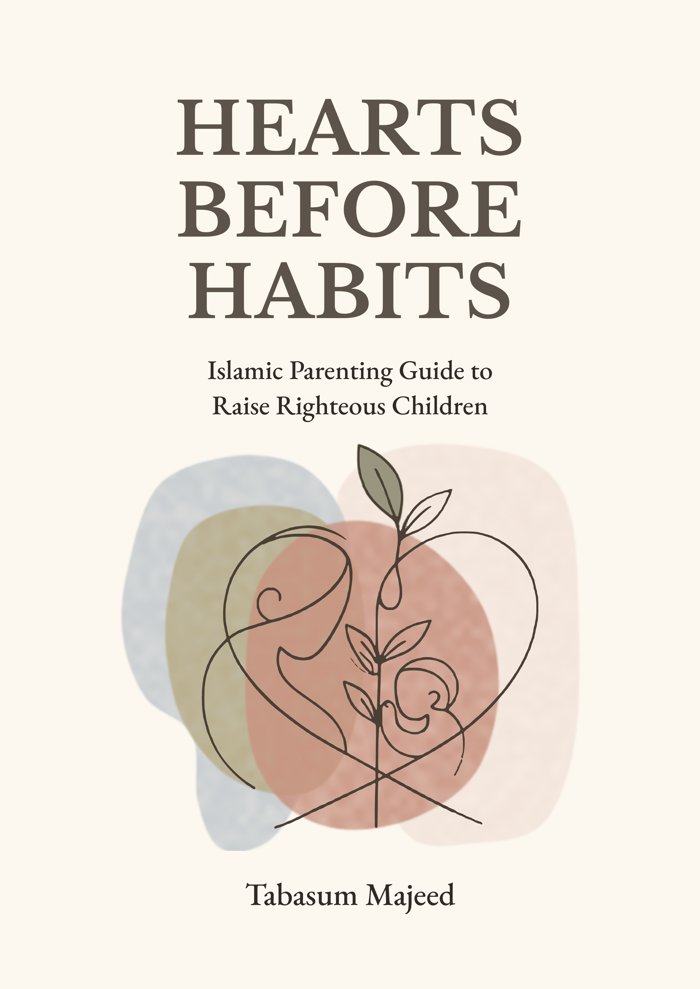
This article draws on Hearts Before Habits — a complete Islamic parenting guide with scripts, du'as, printables and a 30-day plan.
See the book Free printables Recommended booksKeep reading

Gentle Parenting in Islam: The Complete Guide for Muslim Moms
Gentle parenting in Islam explained — what the Quran and Sunnah teach about mercy, boundaries and discipline, with real scripts for everyday moments.
Read the article →
How to Discipline a Child in Islam: Gentle, Firm and Fair
How to discipline a child in Islam without hitting or shaming — the Prophet's example, clear boundaries, fair consequences and scripts by age for Muslim moms.
Read the article →
Toddler Tantrums: A Gentle Islamic Approach for Muslim Moms
Toddler tantrums in Islam — why they happen, what the Sunnah teaches about patience and mercy, and a calm step-by-step plan with scripts for ages 1–4.
Read the article →